28 January 2012

M brooch finally finished

Maria brooch in silver is ready-to-wear.
I must admit that it turned out very nice. Unfotrunately I can't show on the photo how those small attached pendants move while wearing . But it makes the brooch hard not to spot.
Curious how it will catch an eye when it will be gold plated! 
The brooch pin is more like the modern ones - much easier to put on then disk brooch types.

For pricing write an email to the address on a contact page.


Posted by Picasa
For more photos of the making of the brooch click here


6 January 2012

Happy New Year everyone! * EN * BON * AN *


I looked for some New Year gifts for you this time.The custom of giving such gifts has a long tradition and it was common  during the Late Middle Ages among the higher class.
In France such presents were known as étrenneus. They where given to lords, family, friends and even to household staff. Often those gifts were jewellery as rings, brooches, pendants, or specially made badges ( also made of silver ). 
Jewels are costy and such expense are known through account books, bills and other written sources telling us a lot aboute this medieval custom.
In 1384 the royal goldsmith Jehan du Vivier was paid to make a hundred and six small silver-gilt badges and they were supposed to be given to the knights and squires of Charles IV as a New Year's Day gift.

 In 1448 King Rene of Anjou gave hundred and eight badges of  fine silver to the lesser members of his household and twelve gold ones to his knights.


Golden ring from Verversdijk (Belgium)
with engraved EN BON AN inscription and floral motive, 15th cent.


From the account of gifts given in 1373 by John of Gaunt, the Duke of Lancater we know that he bought jewelry from several London goldsmiths: 
'for divers silver-gilt hannaps and divers gold beads [paternosters] and gold brooches and rings and phials and other jewels bought from them for us and given away on New Year's Day at Eltham last year'.

Silver ring with traces of gold gilt found in Hampshire ( England)
with engraved words EN BON AN words separated by floral motives and crosses, 15th cent

For the New Year's Day in 1392 Valentina Visconti, Duches of Orleans, bought a whole list of jewels from the Paris goldsmith and precious stones seller Jehan Tarenne:
"a fine large square diamond for her brother-in-law the King, followed by rings set with a sapphire or other precious stones or pearls for such humble but important persons as nurses to Princess Isabelle and Princess Jeanne, the Kings daugthers, or the Queen's femme de chambre, washer-woman and workman."


Golden ring found in Lincolnshire ( England)
with engraved words EN BON ANNE separated by floral ornaments, 15th cent

and the last but definitely not the least New Year's gift find:


Golden ring found in Kent (England)
with a figure of John the Evangelist on the top and the engraved words EN BON AN on a twisted band, 15th cent.


Posted by Picasa
The catalogue database note:
"A Medieval finger-ring, iconographic in type, engraved at its centre with the image of a standing saint, possibly St John the Evangelist, holding a chalice in his left hand and blessing it with his right. The ring is a highly original construction of geometric planes, creating an exaggerated point at the shoulder. Each plane is engraved with a sunburst and sprigs of foliage. The back of the hoop is cabled and carries an inscription punctuated by engraved flowers. The inscription is contrary to the orientation of the image and reads:

"EN BON AN"

This French inscription, wishing a good year, appears on a large number of medieval rings which are considered to have been New Year's gifts."


Bibliography:

Lightbown, R. W.: Mediaeval European Jewelry . London 1992, p.71-72, 198

http://www.coleurop.be/template.asp?pagename=histoire_verversdijk_arch

http://www.winchestermuseumcollections.org.uk/index.asp?page=item&mwsquery={collection}={archaeology}&id=47
http://finds.org.uk/database/artefacts/record/id/269545

http://finds.org.uk/database/artefacts/record/id/200144


17 December 2011

M for Maria - late 14th cent. brooch from Germany

Something a bit more secular this time - a luxury object of personal devotion.

In 1870 during some construction works at Pritzwalk (Germany) the large number of late medieval silver items had been discovered.
After the examination the researchers came to a conclusion that this treasure was probably hidden in 1392. It consisted 426 jewellery items and a number of jewellery fragments.
Unfortunately the treasure was moved from Pritzwalk to Berlin Decorative Art Museum and some of the items has been destroyed ( also including a beautiful wearable pendant altar with three kings visiting Christ) during the II World War bombing.

Hundreds of beautiful items survived, though and it was really hard to decide what to make first!
After hours of studying the catalogue- that was my pick.

The silver brooch in a shape of crowned letter M.


A wax model of a copy of the silver, late14th century brooch.


Letter M stands for Maria -Mother of Christ. 
The background of the letter is engraved with six four petal flowers and letters A and V- which stands for AVE.
There is also an additional element, a small leave-shaped pendant suspended with a silver wire eye soldered at the back. In the centre of the pendent the is an eye soldered with a silver foil hanging ornament ( very similar to the one from Erfurt Treasure hooks-and-eyes I made - you can see it here )
All elements are enemelled.
At the revers the hinged pin with a closing hook is still preserved.


The original brooch from Pritzwalk Treasure, now in Kunsgewerbetmuseum Collection in Berlin
Material: Silver, gold gilt, enamel
Dimensions: 50mm ( with pendant) x 2,1mm


Bibliography
Krabath, Stefan; Lambacher, Lothar: Der Pritzwalker Silberfund. Smuck des späten Mitelalters, Pritzwalk 2006

10 December 2011

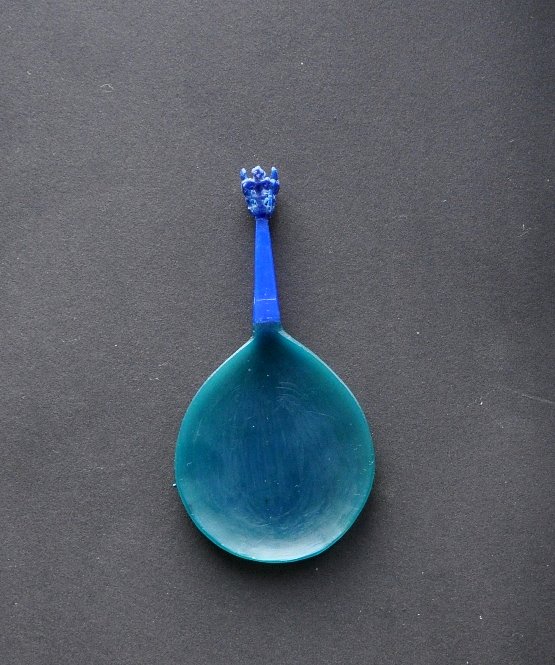
Silver crowned spoon

Getting ready for a royal feast. Silver spoon found in Sweden. This is one of seven similar spoons found in a large silver treasure discovered in Sollentuna and now in the collection of the Historiska Museet.
I just finished the wax few days ago. The final shape of the spoon will me made after it will be casted in metal - i will hammer it to make it deeper. Afterwards the ornaments will be engraved and partly plated with gold.


Wax model of the silver spoon form the Historiska Museet.


Black and white version to give a better idea of how it will look in silver.

The picture of the spoons together with all the treasure elements.


Spoons photographed with the rest of the treasure: cups, belt elements, buttons, candleholder.

Finally the original spoon front and back view. Note the beautiful engraved and plated ribbon under the handle.


The original spoon from the Historiska Museet.
Material:    silver, gold plated
Dimension:    length 122 mm
Bibliography
http://www.historiska.se/data/?foremal=43421
 
Posted by Picasa

1 December 2011

Hooks-and-eyes from Erfurt

Today a short break from making reliquaries. Today there is going to be something about fashion - clothes fasteners from a 14th century treasure from Germany.

It was made using a brass blowpipe not a modern gas burner - something I learned from a goldsmith in India during the last trip ( Yes, there will be a post about it soon).

Copy of the leave hook and eye from the Erfurt Treasure
Material: silver
Dating: 14th century


The photo of the original two pairs of fasteners.

The original fasteners from the Erfurt Treasure
Material:   silver, gold gilt
Dating:  14th century


 At the photo above, the ears in the front side are preserved only on one of the leaves and were used for adding some small metal hanging pendants. Unfortunately it seems that they easily getting lost - but another element from the same treasure still have them preserved.


The belt stud from the Erfurt Treasure with a metal pendant
Few of the belt-studs still have those pendants attached, so I decided to reconstruct a similar heart-shaped ones for my fasteners.

There are many more very interesting hooks-and eyes from Erfurt and they will be available to order soon.

More copies of the Erfurt Treasure elements waiting for soldering.

Silver floral fasteners from Erfurt Treasure

Silver fleur-de-lis fastener form Erfurt Treasure


The Erfurt Treasure- all elements.


The Erfurt Tresure - detail.

Bibliography

Mecking, Oliver (el al.): Der Schatzfund - Analysen - Herstellungstechniken - Rekonstruktionen. Die Mittelalterliche Judische Kultur in Erfurt, Bd. 2.Weimar 2010.


30 November 2011

Metropolitan gothic pendant

Another example of wearable reliquary. The construction is very similar to the IHC reliquary I already made.
I assume this was also open-able, slide up one although I did not find information about it.


The front panel with a architectural motive of gothic windows was made with a cast. The back panel  engraved with a hunting motive - rabbit being chased by three hounds.

This is still "work in progress" project but photos already give an idea of how it will look finished.


Front and back panel of the pendant.


Here are also some photos of the making process. I made the wax model mostly with a "build-up" technique and then made engravings in the background. Some wax, alcohol burner, a few metal instruments and some hours is all what is needed.
 
Making the wax model of the front panel.

  And for comparison:

The original pendant from the Metropolitan Museum in New York
Material: silver, gold gilt
Dimensions: 57mm x 25mm x 7mm
Dating: late 14th century
The museum catalogue says that it got also inscriptions on the sides de Sca Barbara de Sco Giorgio [Saint Barbara Saint George] unfortunately I have no pictures or drawings of the inscriptions. That means I will not make any engraving until I obtain some more photos or before I will go for trip to New York and see it on the display myself.

If you maybe have some more photos of it please do not hesitate to contact me!

Bibliography


28 November 2011

Reliquary pendant with St. George

It has been few months already I am in to finding a making medieval wearable jewellery reliquaries.
This one with a Saint George killing the dragon was made for a commission order. 

It is a tiny piece made in gold plated silver with a rock crystal window - so the stored a precious item always would be visible.
Copy of the 15th cent pendant
Material: 925 Silver (gold plated), rock crystal
Dimensions: 16mm x 14mm x 5mm

The original piece is from the British Museum and the catalouge description says: "Gold reliquary pendant of rectangular shape, engraved with a standing figure of St. George killing the dragon within an arch on one side; on the other is a piece of crystal behind which it is likely that a piece of textile was shown."

The original pendant from British Museum
Material: gold, rock crystal
Dimensions: 16mm x 14mm
You can wear in on a chain, but there is also one nice example from 15th century of a very similar looking item on a black bead ( jet beads?) necklace.
Detail from “Salmon Is questioned by the King”. Pierre Salmon, Dialoges;
Geneva, BGE, MS fr.165, fol.7; Paris, ca.1414.
After van Buren 2011, p. 131, F82.

And some more pictures:


Bibliography
van Buren, Anna H.: Illuminating fashion. Dress in Art of Medieval France and the Netherlands, 1325-1515. New York & London 2011, p. 131, F82.