Showing posts with label inscriptions. Show all posts

4 February 2012

E letter love locket-brooch from th Metropolitan Museum

As the February is considered to be the month of love - today I got a medieval lover gift.

It is a brooch but it is also a locket - it has a hinge and after turning a small lock, it opens and shows the inscription: 

 • V/REWELININ • VRME DEI + HERZE • LEVE• /NSTE • MOIS IC IN • /•SIN 
 which means
"Fair lady, may I always remain close to your heart."
 
Those words are safely kept from the sight of others and only a wearer knows about them.
Inside the brooch there is some space which might be used for storing some kind of a small gift, a reminder of the adorer, like a piece of hair - secular love relict.
All that features together creates a very intimate piece of jewellery and something far more precious than gold and all pearls it is made of.

The copy of the brooch unlocked and in two parts, before fixing the hinge rivet.

 The cover of the brooch has a shape of letter E and in its centre bears the figure of a man holding arrows aimed at his heart. The small holes seen on the top are the places where six small pearls will be set (there is still one remaining at the original brooch)


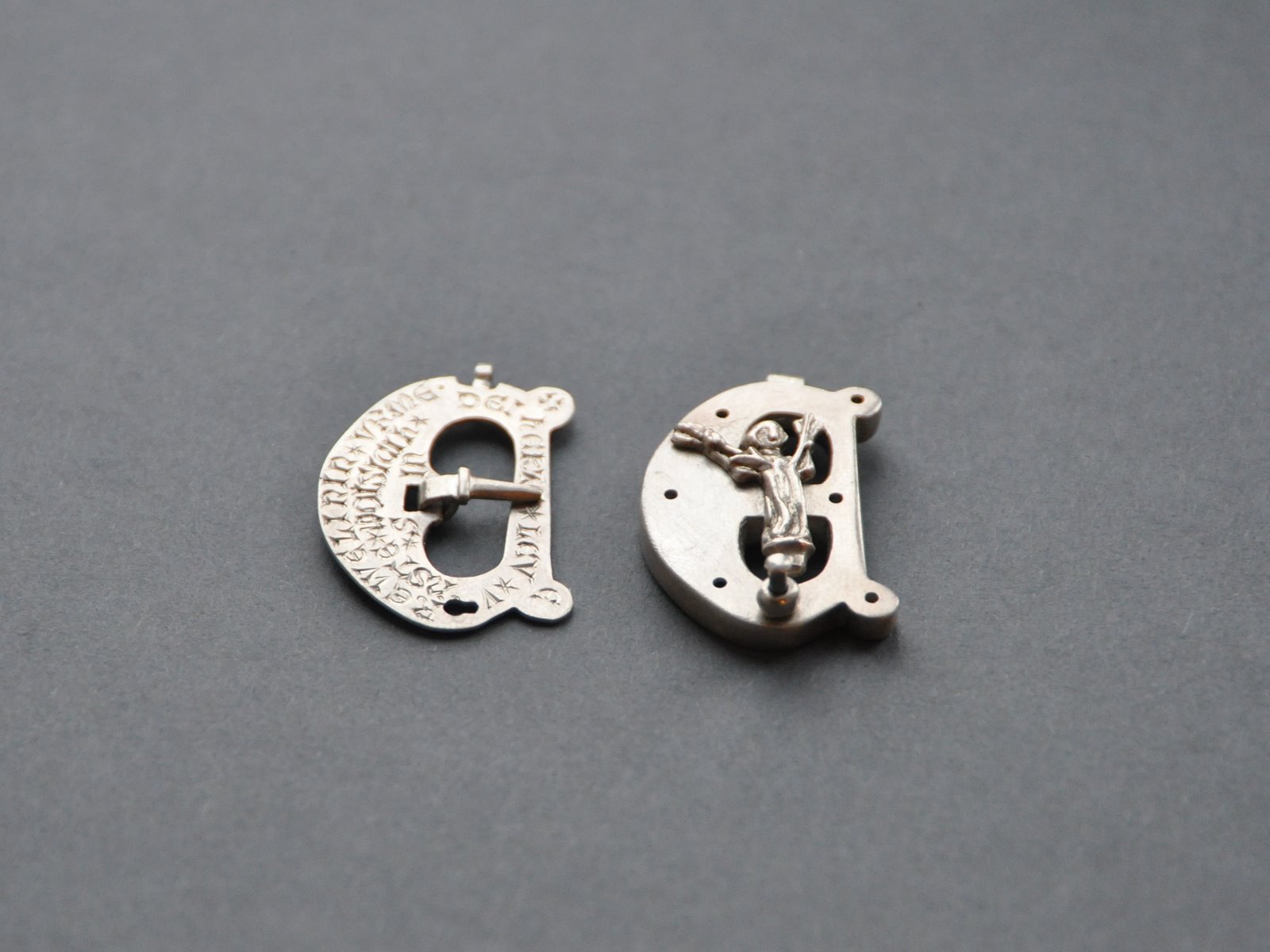
  
It was probably originally manufactured in second half of the 14th century in Southern Germany (the inscription is giving some hints as it seems to be written in a Saxon dialect).

The original brooch from the Metropolitan Museum- closed
Material: silver, gold plated
Dimensions: 32mm x 22mm x 38mm
Dating: late 14th century.

The original brooch from the Metropolitan Museum - open.
A few more photos of the making process so far.
I started with preparing the wax models. The corpus of the letter was cut and carved hollow inside and the figure of the man was made with a wax build-up technique.

Wax models

After casting, all elements were assembled together. The figure was riveted on place, the hole for a closing lock was cut in the back panel and the closing "hook" with a silver bead was set. The pin was installed inside.

Putting on this brooch is probably not the most convenient, but after it is made you can be sure it is safe and quite difficult to lose.

 How to wear it? First, the lock have to be open, than the piece of cloth has to be pulled thru the hole in a back panel and punched thru with a pin. After straightening the cloth brooch is on and you need only to close it again to keep the inscriptions hidden.
Here are photos of the brooch just before the engravings were made were you can see how it is constructed.

Closed brooch without pearls.


Bibliography
http://www.metmuseum.org/collections/search-the-collections/70009901


Posted by Picasa

6 January 2012

Happy New Year everyone! * EN * BON * AN *


I looked for some New Year gifts for you this time.The custom of giving such gifts has a long tradition and it was common  during the Late Middle Ages among the higher class.
In France such presents were known as étrenneus. They where given to lords, family, friends and even to household staff. Often those gifts were jewellery as rings, brooches, pendants, or specially made badges ( also made of silver ). 
Jewels are costy and such expense are known through account books, bills and other written sources telling us a lot aboute this medieval custom.
In 1384 the royal goldsmith Jehan du Vivier was paid to make a hundred and six small silver-gilt badges and they were supposed to be given to the knights and squires of Charles IV as a New Year's Day gift.

 In 1448 King Rene of Anjou gave hundred and eight badges of  fine silver to the lesser members of his household and twelve gold ones to his knights.


Golden ring from Verversdijk (Belgium)
with engraved EN BON AN inscription and floral motive, 15th cent.


From the account of gifts given in 1373 by John of Gaunt, the Duke of Lancater we know that he bought jewelry from several London goldsmiths: 
'for divers silver-gilt hannaps and divers gold beads [paternosters] and gold brooches and rings and phials and other jewels bought from them for us and given away on New Year's Day at Eltham last year'.

Silver ring with traces of gold gilt found in Hampshire ( England)
with engraved words EN BON AN words separated by floral motives and crosses, 15th cent

For the New Year's Day in 1392 Valentina Visconti, Duches of Orleans, bought a whole list of jewels from the Paris goldsmith and precious stones seller Jehan Tarenne:
"a fine large square diamond for her brother-in-law the King, followed by rings set with a sapphire or other precious stones or pearls for such humble but important persons as nurses to Princess Isabelle and Princess Jeanne, the Kings daugthers, or the Queen's femme de chambre, washer-woman and workman."


Golden ring found in Lincolnshire ( England)
with engraved words EN BON ANNE separated by floral ornaments, 15th cent

and the last but definitely not the least New Year's gift find:


Golden ring found in Kent (England)
with a figure of John the Evangelist on the top and the engraved words EN BON AN on a twisted band, 15th cent.


Posted by Picasa
The catalogue database note:
"A Medieval finger-ring, iconographic in type, engraved at its centre with the image of a standing saint, possibly St John the Evangelist, holding a chalice in his left hand and blessing it with his right. The ring is a highly original construction of geometric planes, creating an exaggerated point at the shoulder. Each plane is engraved with a sunburst and sprigs of foliage. The back of the hoop is cabled and carries an inscription punctuated by engraved flowers. The inscription is contrary to the orientation of the image and reads:

"EN BON AN"

This French inscription, wishing a good year, appears on a large number of medieval rings which are considered to have been New Year's gifts."


Bibliography:

Lightbown, R. W.: Mediaeval European Jewelry . London 1992, p.71-72, 198

http://www.coleurop.be/template.asp?pagename=histoire_verversdijk_arch

http://www.winchestermuseumcollections.org.uk/index.asp?page=item&mwsquery={collection}={archaeology}&id=47
http://finds.org.uk/database/artefacts/record/id/269545

http://finds.org.uk/database/artefacts/record/id/200144