Showing posts with label silver. Show all posts

31 October 2012

Amethyst pie-crust ring.


I do make projects with precious stones sometimes.
Here is one of the latest ones: a silver, gold gilded ring with a deep violet coloured amethyst.
 This high setting of the stone allows the light to make all those beautiful reflexes with in the stone - giving more "life" in it.

To show the actual size, few photos of the ring in use.


For comparison - the ring from the Erfurt Treasure I try to reproduce. Only the gold setting with the stone survived the band probably was cut away and re-melted or re-used for other piece of jewellery.


I am often asked about which gems where used in Middle Ages. That a good  moment to put here a  little more information about it.

Most of the precious stones used in medieval jewellery was imported from the Far East. From the region of India, Afghanistan, Burma, Sri Lanka. Some where also mined in Europe, like garnets. They came from region of Bohemia (Czech Republik) which made them much available and affordable, that is why they are among the most popular of stones used in jewellery.
The shaping of the stones was still a new and a costly craft in 14th and 15th century, so most of the stones are being left in their natural shape just polished to give them more shine. This type of stone shape is called cabochon.

Here is a few more examples of similar rings with different types of stones.

Another gold ring from the same Erfurt Treasure with almandine ( a type of garnet).
      

Two gold rings from the Clomar Treasure with a red garnet and with a green tourmaline.


The knowlege of different types of stones and how to check their quality was a important knowlege for many merchants. I one of the letters from 1440 a Florentine merchant Giovanni da Uzzano, shares his opinion  about the most desirable precious stones in all colours and how to judge their quality.

"Fine rubies should be like goodly pomegranate seeds,
good balas-rubies should be like a pomegranate that is not well ripened,
a good emerald will show greener than any other green it is laid beside,
a good topaz is like shining gold, and most of them look as if they are split.
A good sapphire resembles good azure pigment, and is on the white side,
a good aquamarine is like sapphire, but more whitish,
a good citrine looks like wax, with something of red in it,
a good garnet looks like a peach flower.
A good diamond looks like steel and is tranlslucent like glass, and has sharp points,
but another sort tends towards yellow, and third sort looks like crystal, though in shape all three are alike.
A good jasper is green, with shining spots, and seems oiled-most of this sort, comes with figures; another kind is brownish green, with red spots.
A good chalcedony is either white with a shade of blue, or white with a shade of yellow.
A good cornelian looks like cherries that are really red.
A good amethysts are violet colour.
A good turquoise looks dove-white in colour and is not transparent."


Bibliography:
Lightbown, R. W.: Mediaeval European Jewelry . London 1992
Mecking, Oliver (el al.): Der Schatzfund - Analysen - Herstellungstechniken - Rekonstruktionen. Die Mittelalterliche Judische Kultur in Erfurt, Bd. 2.Weimar 2010. 

4 February 2012

E letter love locket-brooch from th Metropolitan Museum

As the February is considered to be the month of love - today I got a medieval lover gift.

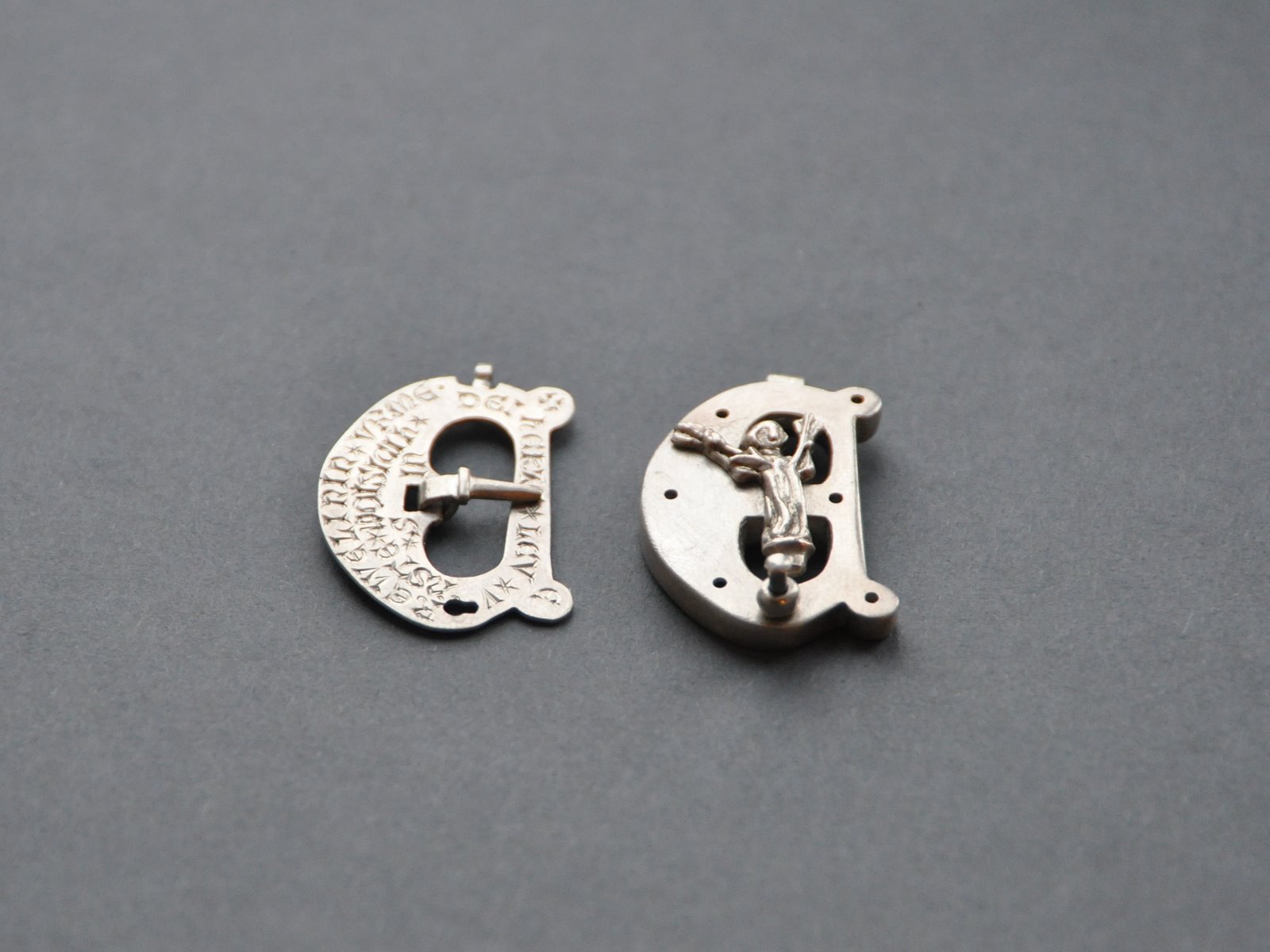
It is a brooch but it is also a locket - it has a hinge and after turning a small lock, it opens and shows the inscription: 

 • V/REWELININ • VRME DEI + HERZE • LEVE• /NSTE • MOIS IC IN • /•SIN 
 which means
"Fair lady, may I always remain close to your heart."
 
Those words are safely kept from the sight of others and only a wearer knows about them.
Inside the brooch there is some space which might be used for storing some kind of a small gift, a reminder of the adorer, like a piece of hair - secular love relict.
All that features together creates a very intimate piece of jewellery and something far more precious than gold and all pearls it is made of.

The copy of the brooch unlocked and in two parts, before fixing the hinge rivet.

 The cover of the brooch has a shape of letter E and in its centre bears the figure of a man holding arrows aimed at his heart. The small holes seen on the top are the places where six small pearls will be set (there is still one remaining at the original brooch)


It was probably originally manufactured in second half of the 14th century in Southern Germany (the inscription is giving some hints as it seems to be written in a Saxon dialect).

The original brooch from the Metropolitan Museum- closed
Material: silver, gold plated
Dimensions: 32mm x 22mm x 38mm
Dating: late 14th century.

The original brooch from the Metropolitan Museum - open.
A few more photos of the making process so far.
I started with preparing the wax models. The corpus of the letter was cut and carved hollow inside and the figure of the man was made with a wax build-up technique.

Wax models

After casting, all elements were assembled together. The figure was riveted on place, the hole for a closing lock was cut in the back panel and the closing "hook" with a silver bead was set. The pin was installed inside.

Putting on this brooch is probably not the most convenient, but after it is made you can be sure it is safe and quite difficult to lose.

 How to wear it? First, the lock have to be open, than the piece of cloth has to be pulled thru the hole in a back panel and punched thru with a pin. After straightening the cloth brooch is on and you need only to close it again to keep the inscriptions hidden.
Here are photos of the brooch just before the engravings were made were you can see how it is constructed.

Closed brooch without pearls.


Bibliography
http://www.metmuseum.org/collections/search-the-collections/70009901


Posted by Picasa

3 February 2012

Silver crowned spoon from the Historiska Museet - next step

The next project is getting closer to its final look.
The spoon from Stockholm is already casted. I have made it in bronze (the final one will be silver).
It has been hammered to make it deeper and engraved.


The copy of the spoon from Historiska Museet with engravings.

The copy of the spoon from Historiska Museet.

Some more pictures before the enravings were made - but they shows nice the final shape after hammering.


The previous post about the making of the spoon can be found here.

Posted by Picasa

Metropolitan gothic pendant- finished

The next piece of jewellery done! And it is a reliquary again.
It has an elaborate gothic architectural design on a front and a hunting scene with hounds chasing a rabbit on the back panel. The holly relicts would be safely kept inside and always stay visible thru two small windows. It is possible to open the pendant - the panel slides down to show the precious content.


The front panel of the reliquary pendant copy from the Metropolitan Museum.
Material: silver, gold plated
Dimensions: 57mm x 27mm x 7mm
Dating: late 14th century.


The back panel with a hunting scene.


The front panel slides down to reveal the relicts stored inside.


For the comparison - the photo of the original pendant.

The original pendant from the Metropolitan Museum in New York
Material: silver, gold gilt
Dimensions: 57mm x 25mm x 7mm
Dating: late 14th century


The previous post about the making of this reliquary can be found here.

Posted by Picasa

28 January 2012

M brooch finally finished

Maria brooch in silver is ready-to-wear.
I must admit that it turned out very nice. Unfotrunately I can't show on the photo how those small attached pendants move while wearing . But it makes the brooch hard not to spot.
Curious how it will catch an eye when it will be gold plated! 
The brooch pin is more like the modern ones - much easier to put on then disk brooch types.

For pricing write an email to the address on a contact page.


Posted by Picasa
For more photos of the making of the brooch click here


17 December 2011

M for Maria - late 14th cent. brooch from Germany

Something a bit more secular this time - a luxury object of personal devotion.

In 1870 during some construction works at Pritzwalk (Germany) the large number of late medieval silver items had been discovered.
After the examination the researchers came to a conclusion that this treasure was probably hidden in 1392. It consisted 426 jewellery items and a number of jewellery fragments.
Unfortunately the treasure was moved from Pritzwalk to Berlin Decorative Art Museum and some of the items has been destroyed ( also including a beautiful wearable pendant altar with three kings visiting Christ) during the II World War bombing.

Hundreds of beautiful items survived, though and it was really hard to decide what to make first!
After hours of studying the catalogue- that was my pick.

The silver brooch in a shape of crowned letter M.


A wax model of a copy of the silver, late14th century brooch.


Letter M stands for Maria -Mother of Christ. 
The background of the letter is engraved with six four petal flowers and letters A and V- which stands for AVE.
There is also an additional element, a small leave-shaped pendant suspended with a silver wire eye soldered at the back. In the centre of the pendent the is an eye soldered with a silver foil hanging ornament ( very similar to the one from Erfurt Treasure hooks-and-eyes I made - you can see it here )
All elements are enemelled.
At the revers the hinged pin with a closing hook is still preserved.


The original brooch from Pritzwalk Treasure, now in Kunsgewerbetmuseum Collection in Berlin
Material: Silver, gold gilt, enamel
Dimensions: 50mm ( with pendant) x 2,1mm


Bibliography
Krabath, Stefan; Lambacher, Lothar: Der Pritzwalker Silberfund. Smuck des späten Mitelalters, Pritzwalk 2006