Showing posts with label Erfurt Treasure. Show all posts

1 July 2013

Rubies and pearls


Gem brooches with sapphires, rubies, garnets and pearls.

Some projects with precious stones and pearls are taking much more time then I would ever imagine. But the way from choosing an object, untill a finished item is a long way.
The most tricky part is the gems. Finding a write type od stone, shape, size, colour and quality that will not ruin the budget takes time. 
For this little brooch I ordered pearls three times before I got the right ones.

 
But let me guide you thru a whole process.

First choose your jewel and find, as many photos, drawing and information about it, as possible. Sometimes it requires a  visit at the museum and making some extra photos from different angels to have enough material to start in the workshop.
I probably will end up with  buying some extra museum catalogues and publications ( you can never have enouth of them! ).

This time I have chosen the brooch from the Erfurt treasure, small elegant with a pin type that is easy to put on the thick textile like a felt hat or a woolen houpelande.
I havent been at the museum in Erfurt yet, but the is a very detailed caltalouge from the exhibition that gives me all the details I need.


The next stage is  finding the right measurements. That you get for the museum database item descriptions or you need to estimate it by your own.
 Making several templates from paper or brass to make sure everything is right, before cutting the metal parts in silver.


All elements are done and fitted together.

 Now the I can finally start in my workshop. Cutting and constructing all elements.
At this stage I already need to have all the stones and pearls. When I am sure that all parts fits together I may solder it to one piece.


  A silver brooch base after soldering and cleaning in the acid.

To set a stone I need to make a tight bezel and after inserting a stone press it tightly around with a polished steel tool.
 Pearls are bit more problematic. If I plan to gold gild the brooch I cannot install the pearls - they are to delicate to survive the acid bath which is used for galvanic gilding. That means I need to rivet it as the very last stage of making the jewel.

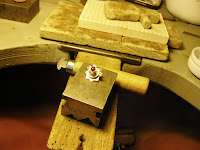
  
Hammering the rivets on back of the pearls requires a steady hand - be sure you hit the metal 0.7mm rivet not the pearl, otherwise you wil need to start all from begining.


Making the first item is always a long process. Next ones can be made much quicker as I do not need again that much time for reaserching, setting measurments and making templates.

But for me whole this stage is the most chalenging and exciting. All those preparation before I even sit in the workshop are the most imoportant and will affect the final look of the project.
The rest is just precision, steady hands and some hours playing with metal: sawing, filing, drilling, soldering, polishing, stone setting, riveting...

31 October 2012

Amethyst pie-crust ring.


I do make projects with precious stones sometimes.
Here is one of the latest ones: a silver, gold gilded ring with a deep violet coloured amethyst.
 This high setting of the stone allows the light to make all those beautiful reflexes with in the stone - giving more "life" in it.

To show the actual size, few photos of the ring in use.


For comparison - the ring from the Erfurt Treasure I try to reproduce. Only the gold setting with the stone survived the band probably was cut away and re-melted or re-used for other piece of jewellery.


I am often asked about which gems where used in Middle Ages. That a good  moment to put here a  little more information about it.

Most of the precious stones used in medieval jewellery was imported from the Far East. From the region of India, Afghanistan, Burma, Sri Lanka. Some where also mined in Europe, like garnets. They came from region of Bohemia (Czech Republik) which made them much available and affordable, that is why they are among the most popular of stones used in jewellery.
The shaping of the stones was still a new and a costly craft in 14th and 15th century, so most of the stones are being left in their natural shape just polished to give them more shine. This type of stone shape is called cabochon.

Here is a few more examples of similar rings with different types of stones.

Another gold ring from the same Erfurt Treasure with almandine ( a type of garnet).
      

Two gold rings from the Clomar Treasure with a red garnet and with a green tourmaline.


The knowlege of different types of stones and how to check their quality was a important knowlege for many merchants. I one of the letters from 1440 a Florentine merchant Giovanni da Uzzano, shares his opinion  about the most desirable precious stones in all colours and how to judge their quality.

"Fine rubies should be like goodly pomegranate seeds,
good balas-rubies should be like a pomegranate that is not well ripened,
a good emerald will show greener than any other green it is laid beside,
a good topaz is like shining gold, and most of them look as if they are split.
A good sapphire resembles good azure pigment, and is on the white side,
a good aquamarine is like sapphire, but more whitish,
a good citrine looks like wax, with something of red in it,
a good garnet looks like a peach flower.
A good diamond looks like steel and is tranlslucent like glass, and has sharp points,
but another sort tends towards yellow, and third sort looks like crystal, though in shape all three are alike.
A good jasper is green, with shining spots, and seems oiled-most of this sort, comes with figures; another kind is brownish green, with red spots.
A good chalcedony is either white with a shade of blue, or white with a shade of yellow.
A good cornelian looks like cherries that are really red.
A good amethysts are violet colour.
A good turquoise looks dove-white in colour and is not transparent."


Bibliography:
Lightbown, R. W.: Mediaeval European Jewelry . London 1992
Mecking, Oliver (el al.): Der Schatzfund - Analysen - Herstellungstechniken - Rekonstruktionen. Die Mittelalterliche Judische Kultur in Erfurt, Bd. 2.Weimar 2010. 

1 December 2011

Hooks-and-eyes from Erfurt

Today a short break from making reliquaries. Today there is going to be something about fashion - clothes fasteners from a 14th century treasure from Germany.

It was made using a brass blowpipe not a modern gas burner - something I learned from a goldsmith in India during the last trip ( Yes, there will be a post about it soon).

Copy of the leave hook and eye from the Erfurt Treasure
Material: silver
Dating: 14th century


The photo of the original two pairs of fasteners.

The original fasteners from the Erfurt Treasure
Material:   silver, gold gilt
Dating:  14th century


 At the photo above, the ears in the front side are preserved only on one of the leaves and were used for adding some small metal hanging pendants. Unfortunately it seems that they easily getting lost - but another element from the same treasure still have them preserved.


The belt stud from the Erfurt Treasure with a metal pendant
Few of the belt-studs still have those pendants attached, so I decided to reconstruct a similar heart-shaped ones for my fasteners.

There are many more very interesting hooks-and eyes from Erfurt and they will be available to order soon.

More copies of the Erfurt Treasure elements waiting for soldering.

Silver floral fasteners from Erfurt Treasure

Silver fleur-de-lis fastener form Erfurt Treasure


The Erfurt Treasure- all elements.


The Erfurt Tresure - detail.

Bibliography

Mecking, Oliver (el al.): Der Schatzfund - Analysen - Herstellungstechniken - Rekonstruktionen. Die Mittelalterliche Judische Kultur in Erfurt, Bd. 2.Weimar 2010.